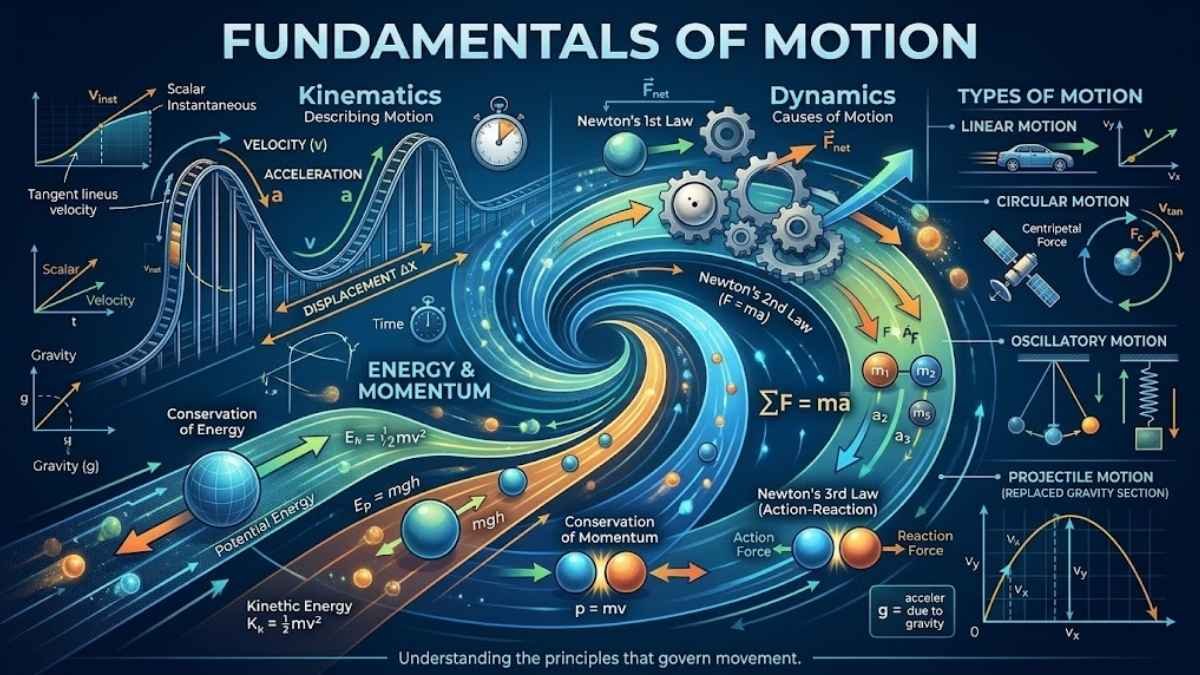
Motion is one of the most basic concepts in physics. Everything around us moves in some way. Cars travel along roads, birds fly through the sky, planets revolve around the Sun, and people walk from one place to another. Even objects that appear stationary may move when observed from a different reference point.
Understanding the fundamentals of motion helps explain how objects change their positions, how quickly they travel, and why their movement changes over time. These concepts form the foundation of mechanics, a major branch of physics.
In this beginner-friendly guide, we will explore motion, distance, displacement, speed, velocity, acceleration, different types of motion, and the important equations used to solve basic physics problems. Each concept includes simple explanations and everyday examples to make learning easier.
What Is Motion in Physics?
Motion is the change in an object’s position over time relative to a reference point. When an object changes its location as time passes, it is considered to be in motion.
For example, when a car moves along a road, its position changes relative to nearby buildings, trees, or road signs. Similarly, a person walking across a room is in motion because their position changes over time.
However, motion depends on the observer’s reference point. A passenger sitting inside a moving bus is at rest relative to another passenger but is moving relative to someone standing beside the road.
This shows that motion is not always absolute. It depends on the frame of reference used to observe an object.
Why Are the Fundamentals of Motion Important?
The study of motion helps us understand how the physical world works. It is useful in everyday activities and many scientific and technological fields.
Some important applications include:
- Transportation: Understanding vehicle speed, braking distance, and acceleration.
- Sports: Analyzing the movement of athletes and the flight of balls.
- Engineering: Designing machines, vehicles, bridges, and moving systems.
- Space exploration: Calculating the movement of satellites, rockets, and planets.
- Everyday life: Estimating travel time, walking speed, and distance.
Motion is also the starting point for understanding Newton’s laws of motion, forces, momentum, and energy.
Basic Terms Used in Motion
Before exploring different types of motion, it is important to understand a few basic physics terms.
| Term | Meaning | SI unit |
|---|---|---|
| Position | Location of an object | Meter (m) |
| Distance | Total path covered | Meter (m) |
| Displacement | Change in position | Meter (m) |
| Speed | Distance covered per unit time | m/s |
| Velocity | Displacement per unit time | m/s |
| Acceleration | Change in velocity per unit time | m/s² |
| Time | Duration of motion | Second (s) |
1. Distance
Distance is the total length of the path traveled by an object, regardless of its direction.
For example, if a person walks 5 meters forward and then 3 meters backward, the total distance traveled is:
Distance = 5 + 3 = 8 meters.
Distance is a scalar quantity because it has magnitude but no direction. It is always zero or positive.
2. Displacement
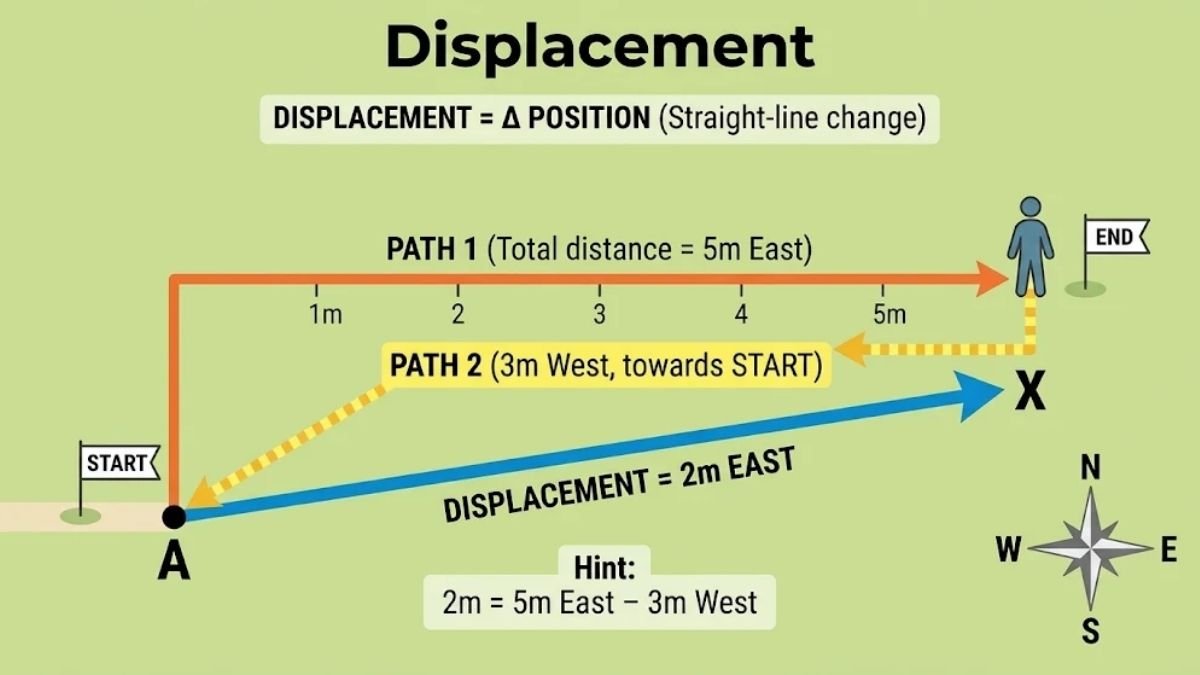
Displacement is the shortest straight-line change in an object’s position from its starting point to its ending point, including direction.
Suppose a person walks 5 meters east and then 3 meters west.
Their displacement is:
Displacement = 5 − 3 = 2 meters east.
Unlike distance, displacement is a vector quantity because it includes both magnitude and direction. It can be zero, positive, or negative depending on the chosen direction.
Difference Between Distance and Displacement
| Distance | Displacement |
|---|---|
| Total path traveled | Change in position |
| Scalar quantity | Vector quantity |
| Has magnitude only | Has magnitude and direction |
| Never negative | Can be positive, negative, or zero |
| Depends on the actual path | Depends on starting and ending positions |
3. Speed
Speed describes how quickly an object covers a distance. It tells us how much distance an object travels in a given amount of time.
The formula for speed is:
\[ \text{Speed}=\frac{\text{Distance}}{\text{Time}} \]
For example, if a car travels 100 meters in 5 seconds:
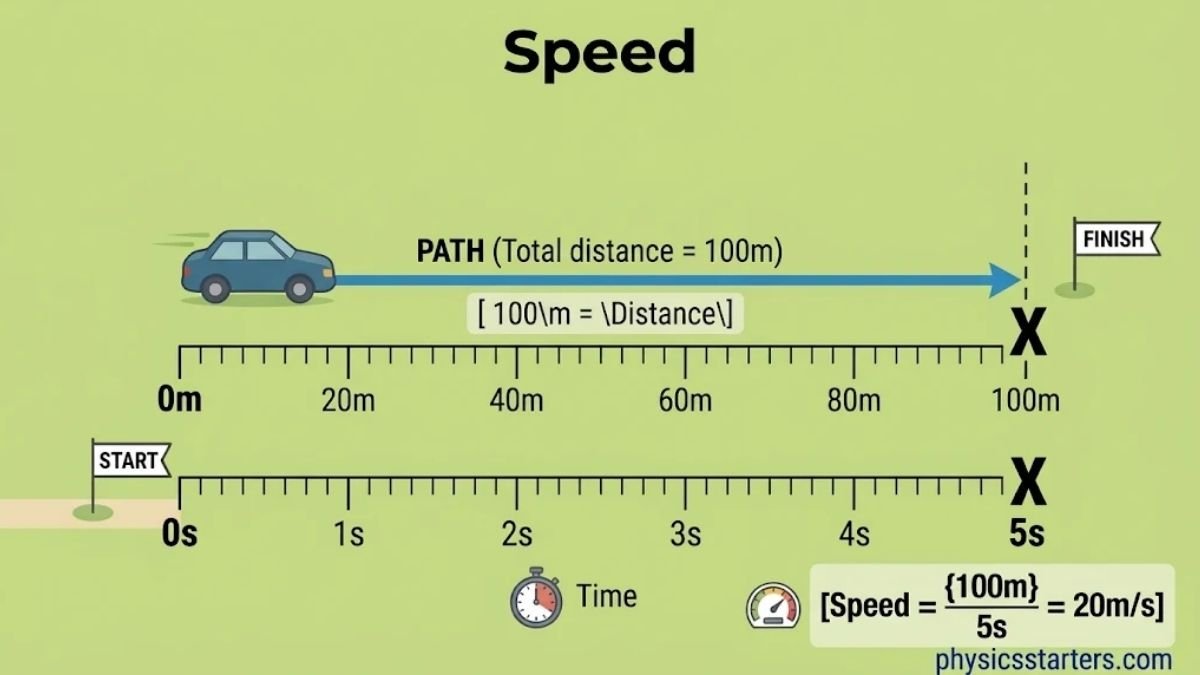
[ text{Speed}=frac{100}{5}=20\text{ m/s} ]
The car’s speed is 20 meters per second.
Speed is a scalar quantity because it does not include direction.
Types of Speed
- Uniform speed: An object covers equal distances in equal time intervals.
- Variable speed: An object covers different distances in equal time intervals.
- Average speed: Total distance divided by total time.
- Instantaneous speed: The speed of an object at a particular moment.
4. Velocity
Velocity describes the rate at which an object’s displacement changes over time. Unlike speed, velocity includes direction.
Its formula is:
[ text{Velocity}=\frac{\text{Displacement}}{\text{Time}} ]
For example, if a cyclist moves 60 meters north in 10 seconds:
[ \text{Velocity}=\frac{60}{10}=6\text{ m/s north} \]
The cyclist’s velocity is 6 meters per second toward the north.
Velocity is a vector quantity. An object can change its velocity by changing its speed, direction, or both.
Difference Between Speed and Velocity
| Speed | Velocity |
|---|---|
| Based on distance | Based on displacement |
| Scalar quantity | Vector quantity |
| Has no direction | Includes direction |
| Always non-negative | Can be positive, negative, or zero |
| Describes how fast an object moves | Describes how fast and in which direction it moves |
5. Acceleration
Acceleration is the rate at which velocity changes over time. An object accelerates when it speeds up, slows down, or changes its direction.
The formula is:
\[ a=\frac{v-u}{t} \]
Where:
- (a) = acceleration
- (v) = final velocity
- (u) = initial velocity
- (t) = time taken
For example, a car increases its velocity from 10 m/s to 30 m/s in 5 seconds.
[ a=frac{30-10}{5} ]
[ a=4\text{ m/s}^2 ]
The car’s acceleration is 4 meters per second squared.
Types of Acceleration
- Positive acceleration: Velocity increases in the chosen positive direction.
- Negative acceleration: Acceleration acts in the negative direction.
- Uniform acceleration: Velocity changes by equal amounts in equal time intervals.
- Non-uniform acceleration: Velocity changes by unequal amounts in equal time intervals.
Deceleration, often called retardation, describes a reduction in speed when acceleration acts opposite to the direction of motion.
Types of Motion in Physics
Objects can move in different ways depending on their paths and behavior. Physics classifies motion into several main types.
1. Rectilinear Motion
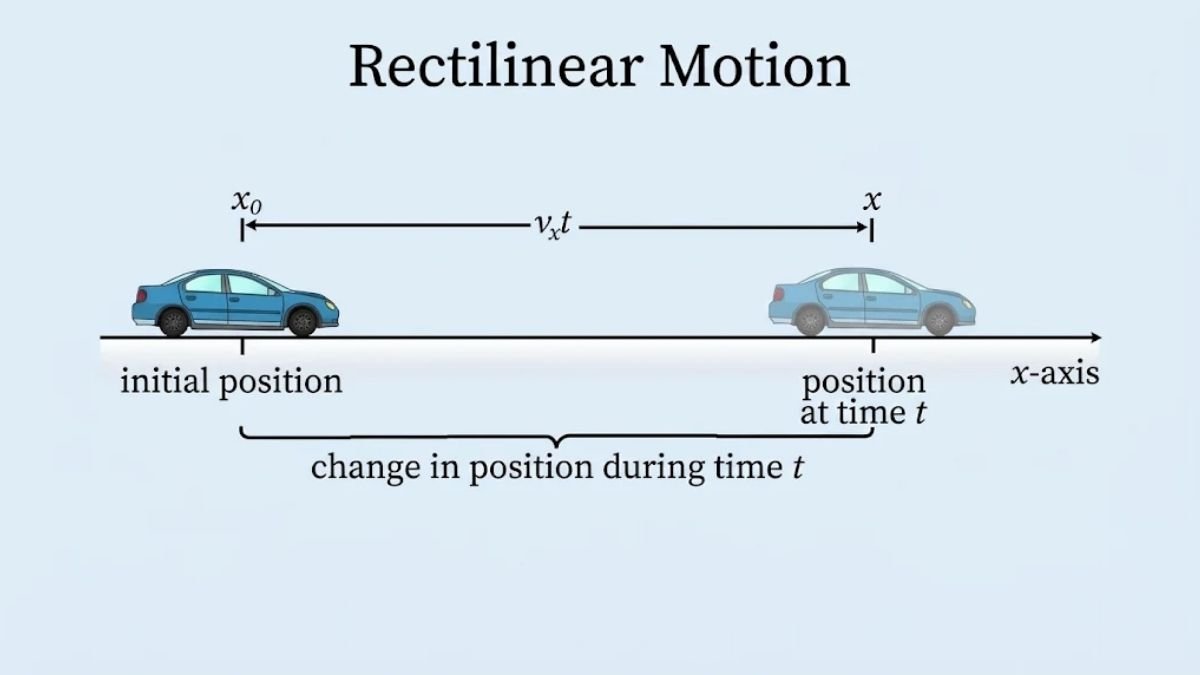
Motion along a straight line. For example, a train moving along a straight railway track.
2. Circular Motion
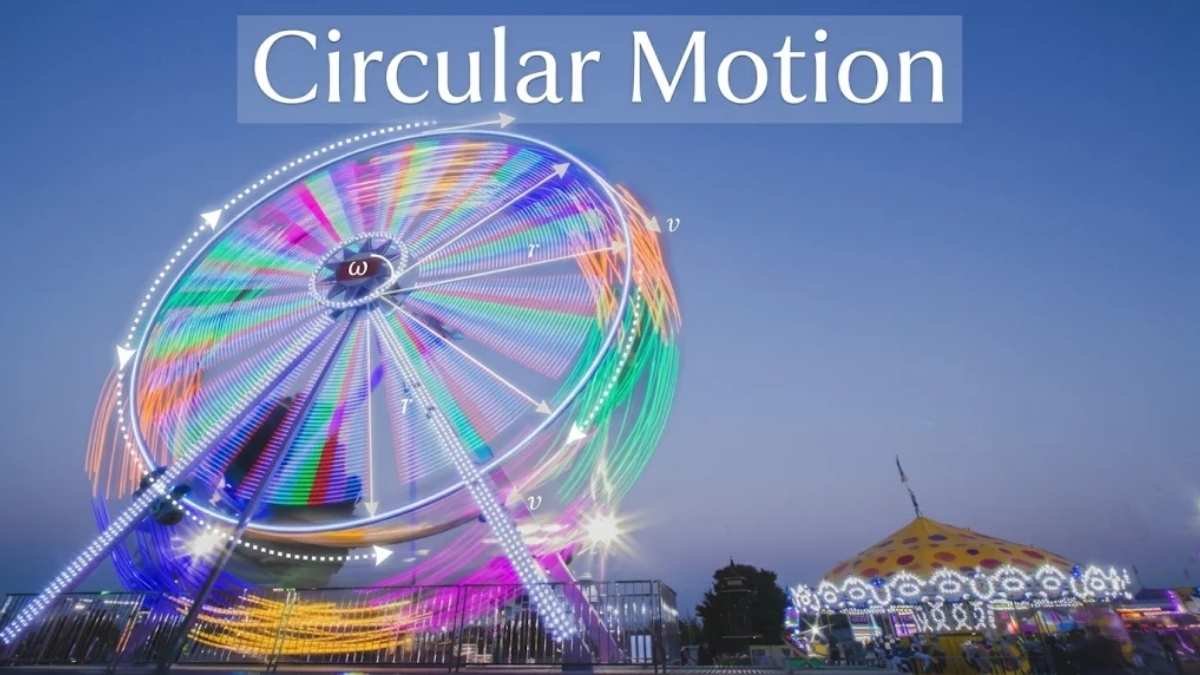
Long exposure of colorful ferris-wheel against a clear blue sky at dusk.
Motion along a circular path. A rotating fan blade and a Ferris wheel are common examples.
3. Oscillatory Motion
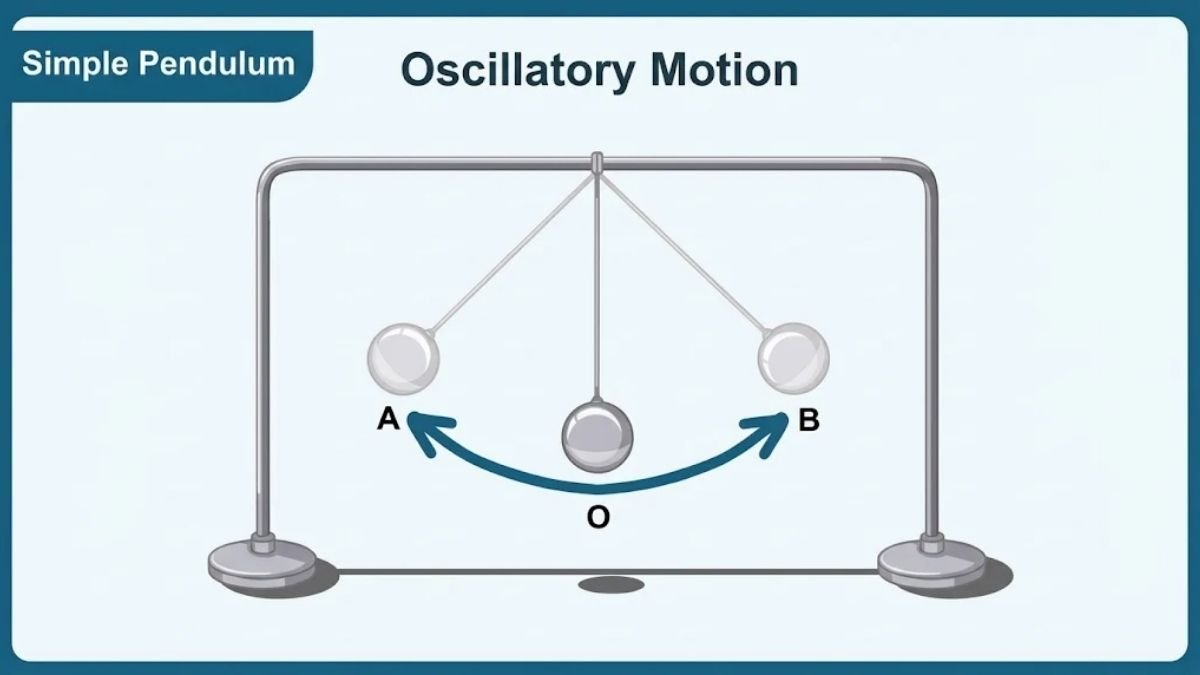
Repeated back-and-forth movement around a central position. A swinging pendulum is an example.
4. Rotational Motion
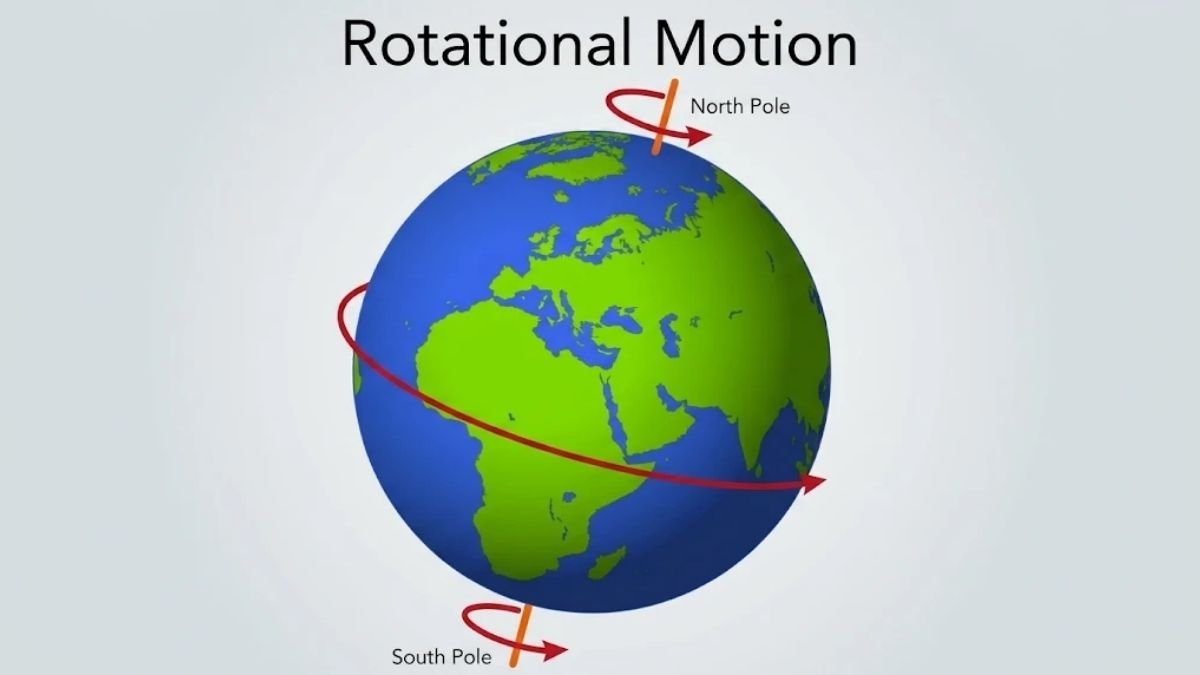
Motion in which an object turns around an axis. Earth rotating around its axis is an example.
5. Curvilinear Motion
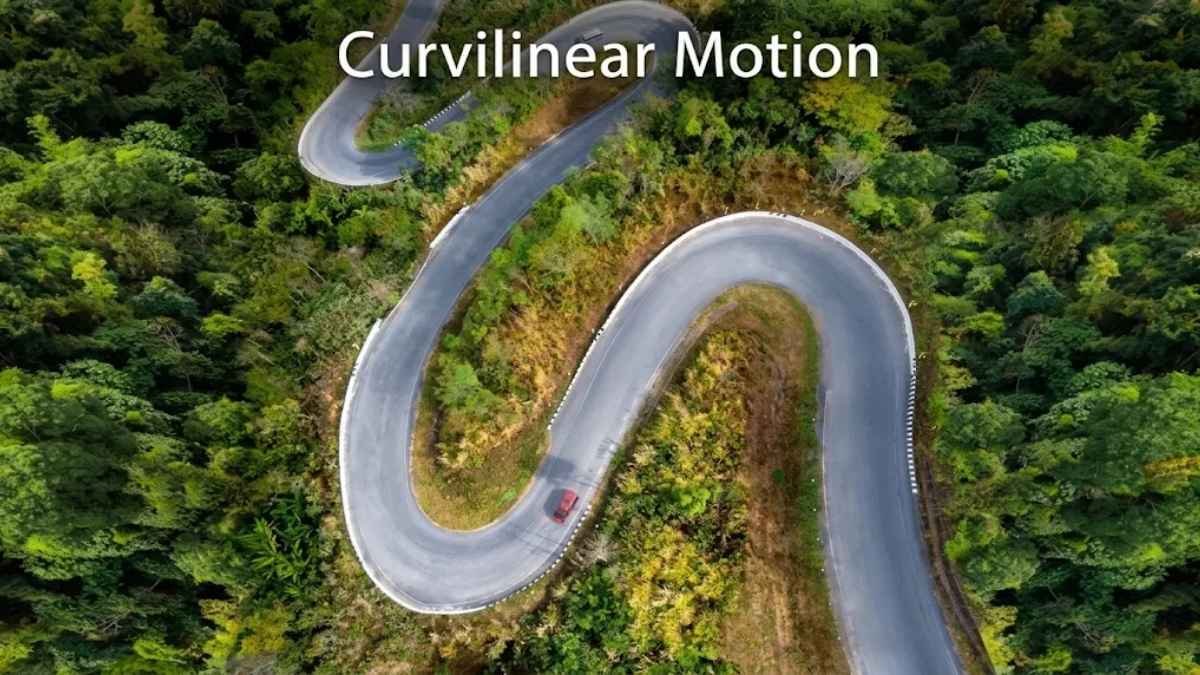
Motion along a curved path. A car traveling around a bend is an example.
6. Projectile Motion
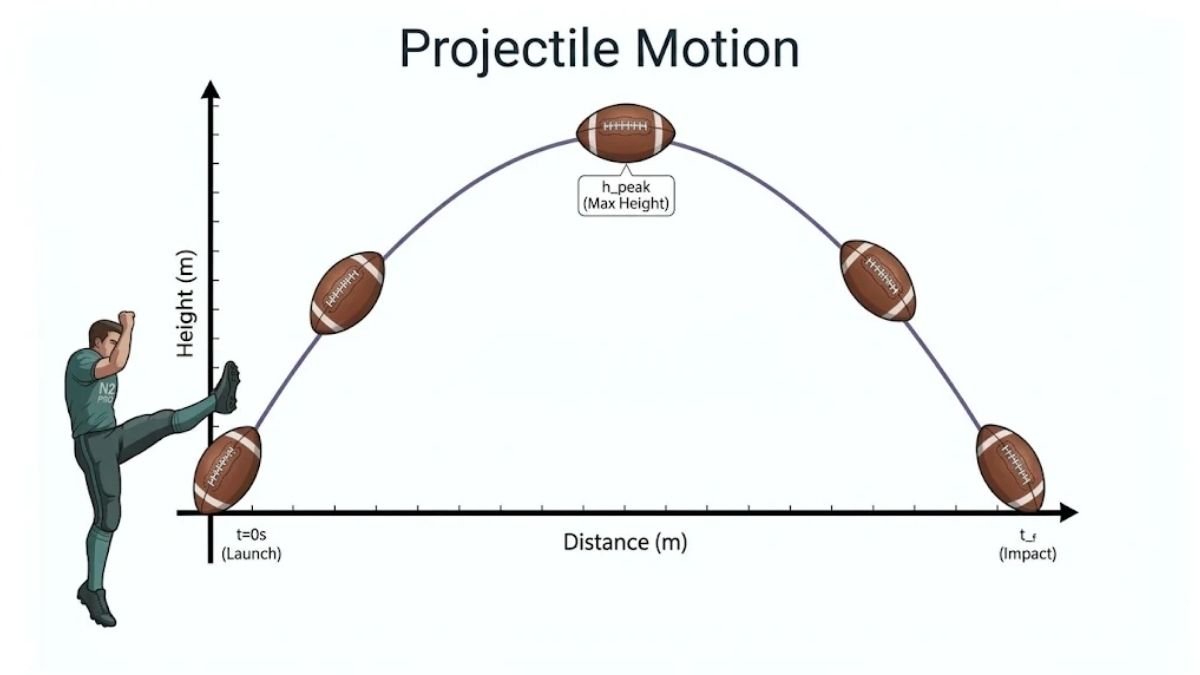
The curved motion of an object thrown or launched into the air under gravity, assuming air resistance is negligible.
Some objects can also show more than one type of motion simultaneously. For example, a rolling wheel rotates around its axis while moving forward.
Uniform and Non-Uniform Motion
Motion can also be classified according to how an object’s position changes over time.
Uniform Motion
Uniform motion occurs when an object covers equal distances in equal intervals of time, regardless of how small the time intervals are.
For example, a car traveling at a constant speed of 20 m/s in a straight line covers 20 meters every second.
Non-Uniform Motion
Non-uniform motion occurs when an object covers unequal distances in equal time intervals or changes its direction.
For example, a bus moving through city traffic frequently speeds up and slows down because of traffic lights, pedestrians, and road conditions.
| Uniform Motion | Non-Uniform Motion |
|---|---|
| Constant speed in straight-line motion | Speed or direction changes |
| Equal distances in equal time intervals | Unequal distances in equal time intervals |
| Zero acceleration in straight-line motion | May involve acceleration |
| Example: Constant-speed conveyor belt | Example: A bus in traffic |
Equations of Motion
The equations of motion describe the relationship between an object’s initial velocity, final velocity, acceleration, displacement, and time.
These equations are particularly useful for solving problems involving constant acceleration in a straight line.
There are three basic equations of motion.
First Equation of Motion
\[ v=u+at \]
This equation calculates the final velocity when initial velocity, acceleration, and time are known.
Second Equation of Motion
\[ s=ut+\frac{1}{2}at^2 \]
This equation calculates the displacement of an object during a specific time under constant acceleration.
Third Equation of Motion
[ v^2=u^2+2as ]
This equation calculates the relationship between velocity, acceleration, and displacement without requiring time.
Meaning of the symbols:
| Symbol | Quantity |
|---|---|
| (u) | Initial velocity |
| (v) | Final velocity |
| (a) | Constant acceleration |
| (t) | Time |
| (s) | Displacement |
These equations assume constant acceleration and straight-line motion. They should not be applied directly to motion with changing acceleration.
Distance-Time and Velocity-Time Graphs
Graphs make it easier to understand how objects move. They show the relationship between motion-related quantities over time.
Distance-Time Graph
A distance-time graph shows how the distance traveled by an object changes as time passes.
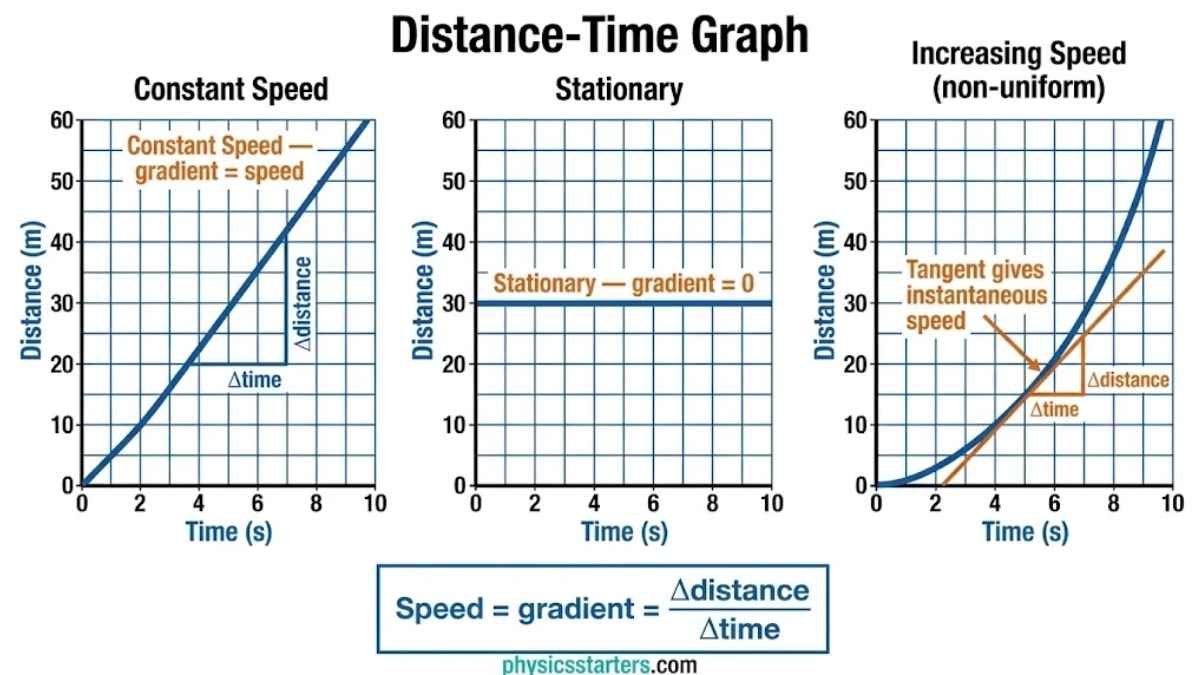
Important features include:
- A straight upward-sloping line represents constant speed.
- A horizontal line represents an object at rest.
- A steeper line represents greater speed.
- A curved line indicates changing speed.
The slope of a distance-time graph represents speed.
Velocity-Time Graph
A velocity-time graph shows how an object’s velocity changes over time.
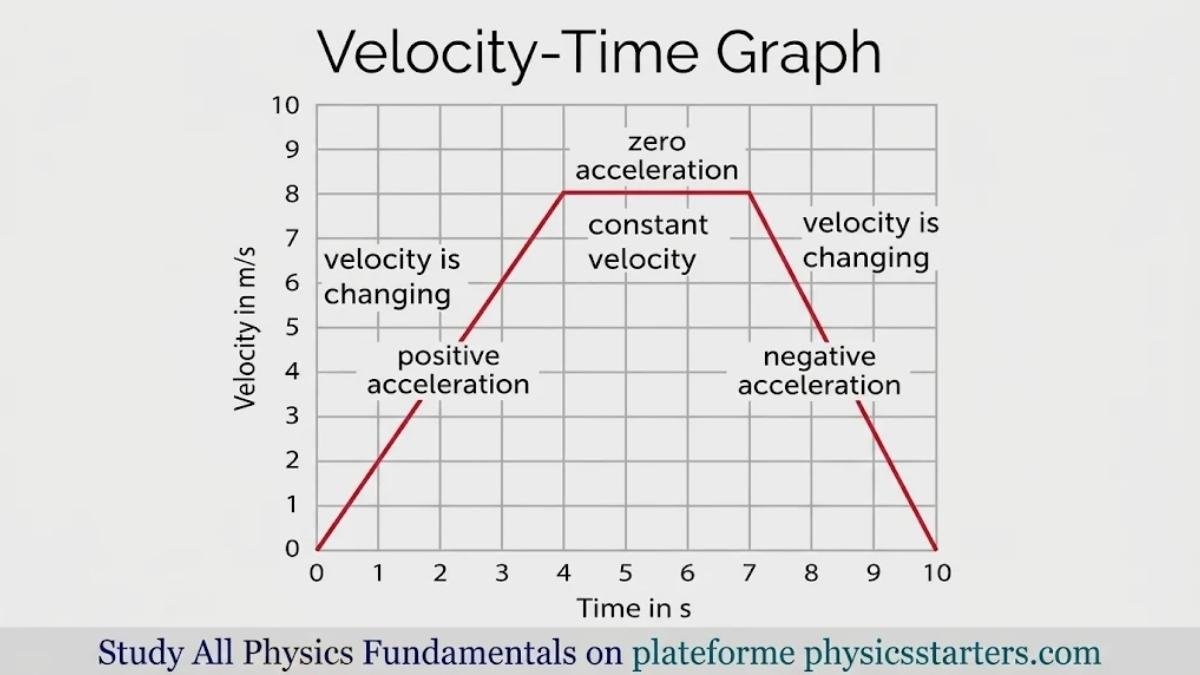
Its important features include:
- A horizontal line represents constant velocity.
- An upward-sloping line represents positive acceleration.
- A downward-sloping line represents negative acceleration.
- The area between the graph and the time axis represents displacement.
Graphs are useful because they allow us to understand motion without calculating every position separately.
Difference Between Scalars and Vectors in Motion
Physics quantities are divided into two main categories: scalars and vectors.
Scalar quantities have magnitude only, while vector quantities have both magnitude and direction.
| Scalar Quantities | Vector Quantities |
|---|---|
| Distance | Displacement |
| Speed | Velocity |
| Time | Acceleration |
| Mass | Force |
For example, saying that a car travels at 60 km/h describes its speed. Saying that it travels at 60 km/h toward the east describes its velocity.
Understanding this difference is essential for solving motion problems correctly.
Real-Life Examples of Motion
Motion is not limited to physics textbooks. We experience it throughout the day.
- Driving a car: A car changing its speed on a highway demonstrates acceleration and deceleration.
- Walking: A person moving between two locations demonstrates displacement and distance.
- Playing football: A kicked ball follows a curved projectile path.
- Riding a bicycle: The wheels demonstrate rotational motion while the bicycle moves forward.
- A swinging clock pendulum: Its repeated movement demonstrates oscillatory motion.
- Earth’s movement: Earth’s rotation and revolution demonstrate rotational and orbital motion.
These examples show how the same physics principles apply to many different situations.
Solved Numerical Problems on Motion
Let’s apply the basic formulas to some simple examples.
Example 1: Calculating Speed
A person walks 120 meters in 20 seconds. What is their average speed?
Given:
- Distance = 120 m
- Time = 20 s
Using the formula:
\[ Speed=\frac{Distance}{Time} \]
\[ Speed=\frac{120}{20}=6\text{ m/s} \]
Answer: The average speed is 6 m/s.
Example 2: Calculating Acceleration
A motorcycle increases its velocity from 5 m/s to 25 m/s in 4 seconds. Calculate its acceleration.
Given:
- Initial velocity = 5 m/s
- Final velocity = 25 m/s
- Time = 4 s
[ a=\frac{v-u}{t} \]
[ a=\frac{25-5}{4}=5\text{ m/s}^2 \]
Answer: The acceleration is 5 m/s².
Example 3: Calculating Displacement
A car starts with an initial velocity of 10 m/s and accelerates at 2 m/s² for 5 seconds. Find its displacement.
Given:
- Initial velocity = 10 m/s
- Acceleration = 2 m/s²
- Time = 5 s
Using:
\[ s=ut+\frac{1}{2}at^2 \]
\[ s=(10)(5)+\frac{1}{2}(2)(5)^2 \]
\[ s=50+25=75\text{ m} \]
Answer: The car’s displacement is 75 meters.
Newton’s Laws of Motion: An Introduction
The fundamentals of motion become easier to understand when we connect them with Newton’s laws. These three laws explain how forces affect the movement of objects.
1. Newton’s First Law of Motion
Newton’s first law states that an object remains at rest or continues moving at a constant velocity unless an external unbalanced force acts on it.
This is also called the law of inertia.
Example: When a moving car suddenly stops, passengers tend to move forward because their bodies resist the change in motion.
2. Newton’s Second Law of Motion
Newton’s second law explains that the acceleration of an object depends on the net force acting on it and its mass.
Its formula is:
\[ F=ma \]
Where:
- \(F\) = Net force (Newtons)
- \(m\) = Mass (kilograms)
- \(a\) = Acceleration (m/s²)
Example: Pushing an empty shopping cart requires less force to produce the same acceleration than pushing a fully loaded cart.
3. Newton’s Third Law of Motion
Newton’s third law states that for every action, there is an equal and opposite reaction.
Example: When a person jumps, their feet push the ground downward, and the ground pushes the person upward.
These laws provide the foundation for understanding the relationship between force and motion.
Common Mistakes Beginners Make When Studying Motion
Beginners sometimes confuse similar physics terms. Understanding these differences makes problem-solving easier.
- Confusing distance with displacement: Distance measures the complete path, while displacement measures the change in position.
- Treating speed and velocity as identical: Speed has magnitude only, while velocity includes direction.
- Ignoring units: Always include appropriate units such as meters, seconds, and meters per second.
- Mixing up acceleration and speed: Acceleration describes a change in velocity, not simply how fast an object moves.
- Using incorrect formulas: Check which values are given before selecting an equation of motion.
- Ignoring direction: Direction matters when working with displacement, velocity, and acceleration.
A good understanding of these basic ideas makes more advanced physics topics much easier to learn.
Frequently Asked Questions (FAQs)
What are the fundamentals of motion?
The fundamentals of motion include position, distance, displacement, speed, velocity, acceleration, time, and different types of movement. These concepts explain how objects move and change their positions.
What are the three basic equations of motion?
The three basic equations are:
\(v=u+at\)
\(s=ut+\frac{1}{2}at^2\)
\(v^2=u^2+2as\)
They apply to straight-line motion with constant acceleration.
What is the difference between motion and rest?
Motion means an object’s position changes over time relative to a reference point. Rest means its position remains unchanged relative to that reference point.
What are the main types of motion?
The main types include rectilinear, circular, rotational, oscillatory, curvilinear, and projectile motion.
What is the SI unit of speed?
The SI unit of speed is meters per second (m/s).
What is the SI unit of acceleration?
The SI unit of acceleration is meters per second squared (m/s²).
Can an object have zero velocity but nonzero acceleration?
Yes. For example, a ball thrown vertically upward has zero instantaneous velocity at its highest point, but its acceleration due to gravity remains directed downward.
Why is acceleration important in physics?
Acceleration helps explain how quickly an object’s velocity changes. It is important for understanding vehicle movement, falling objects, sports, and many mechanical systems.
What is the difference between uniform and non-uniform motion?
Uniform motion involves equal distances covered in equal time intervals. Non-uniform motion involves unequal distances in equal time intervals or a change in direction.
Conclusion
The fundamentals of motion provide the foundation for understanding how objects move and interact with the world around them. Concepts such as distance, displacement, speed, velocity, and acceleration help explain different aspects of movement.
Learning the types of motion, equations of motion, graphs, and Newton’s laws makes it easier to understand real-life situations, from driving a car to watching a ball travel through the air.
For beginners, the best way to learn these concepts is to understand the meaning of each term, remember the basic formulas, and practice simple numerical problems. Once these foundations are clear, studying advanced topics such as force, momentum, gravity, and energy becomes much easier.
